The Bush Doctrine and the War on Terrorism: Global Responses, Global Consequences by Mary Buckley & Robert Singh
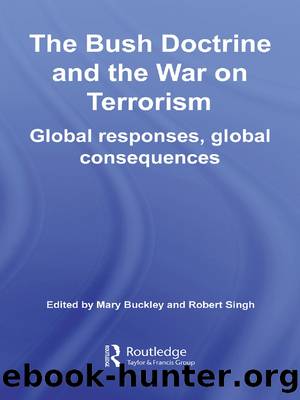
Author:Mary Buckley & Robert Singh [Buckley, Mary & Singh, Robert]
Language: eng
Format: epub
Tags: Political Science, International Relations, General, Terrorism, Technology & Engineering, Engineering (General)
ISBN: 9780415368315
Google: OsRutAEACAAJ
Goodreads: 8464409
Publisher: Routledge
Published: 2006-01-15T06:52:06+00:00
Post-9/11 order
In its first year, the administration had shown little interest in the broader Middle East problems such as the stalled ArabâIsraeli peace process or the threat of political Islam. Where âIslamic terrorismâ was noted as a problem, it was largely in the context of Israelâs security dilemmas. After the horrific events of 9/11, however, the âgreaterâ Middle East (including North Africa, Central Asia, Afghanistan and Pakistan) emerged as Bushâs main foreign policy preoccupation, and pursued, some have suggested, for very narrowly defined ends (see, for example, Ahmed 2003). While interest in âregime changeâ in Iraq had already been demonstrated from 2000, 9/11 helped in creating a security calculus for the Middle East that not only produced the âaxis of evilâ doctrine in January 2002 but also brought into sharp focus in this region the application of the pre-emptive strike doctrine, and the war on terrorism.3
In relation to pre-emption, the talk in the immediate aftermath of 9/11 was of US preparations for a strike on Iraq for its alleged role in the September attacks and the development of WMD. Although no links were established, after Afghanistan, Iraq was to find itself at the top of the US hit list, with its leader branded as âevilâ by the American president.4 Fears of a pre-emptive strike on Iraq were so rife that one of the USâs closest regional allies, King Abdullah of Jordan, went on record in October warning of the disastrous consequences of such an act for the region and for the USâs finely balanced anti-terror coalition. He told the Financial Times that âthere is no proof of Iraqi responsibility vis-Ã -vis the September 11 attacksâ and that âit would be a serious blow if Iraq was targeted and it would be detrimental to the international effort against terrorismâ.5 Leaders of several other Arab states, including those unfriendly to Iraq (Syria, Saudi Arabia and Egypt), expressed similar reservations. The Arab League, the âmouthpieceâ of the Arab world, did likewise on more than one occasion.
Taking no heed, Bush reinforced his administrationâs growing anti-Iraq position by hinting twice in two days in November 2001 that action could be taken against Iraq. The State Departmentâs Richard Haass mused that âweâd be able to make the case that this [attack on Iraq] isnât a discretionary action but one done in self-defenceâ.6 In the late Hugo Youngâs perceptive words, uttered before even 2001 was out: âAmericans want a war on Iraq and we canât stop them.â7
The spread of democracy to the Muslim Middle East, particularly the Arab world, as a US political and security imperative emerged at the same time. By late 2002, the need for political reform (democratization) in the greater Middle East had became an added condition of US concerns over guaranteeing global security, creating with one stroke a securityâdemocratization nexus in the Middle East region.
But it was the post-9/11 war on terror, conducted against al-Qaeda and its related militant Islamist groups, that became the single most important dimension of Bushâs interaction with the Middle East.
Download
This site does not store any files on its server. We only index and link to content provided by other sites. Please contact the content providers to delete copyright contents if any and email us, we'll remove relevant links or contents immediately.
| Anthropology | Archaeology |
| Philosophy | Politics & Government |
| Social Sciences | Sociology |
| Women's Studies |
The Secret History by Donna Tartt(19088)
The Social Justice Warrior Handbook by Lisa De Pasquale(12190)
Thirteen Reasons Why by Jay Asher(8909)
This Is How You Lose Her by Junot Diaz(6886)
Weapons of Math Destruction by Cathy O'Neil(6279)
Zero to One by Peter Thiel(5801)
Beartown by Fredrik Backman(5754)
The Myth of the Strong Leader by Archie Brown(5507)
The Fire Next Time by James Baldwin(5444)
How Democracies Die by Steven Levitsky & Daniel Ziblatt(5218)
Promise Me, Dad by Joe Biden(5153)
Stone's Rules by Roger Stone(5087)
A Higher Loyalty: Truth, Lies, and Leadership by James Comey(4963)
100 Deadly Skills by Clint Emerson(4925)
Rise and Kill First by Ronen Bergman(4788)
Secrecy World by Jake Bernstein(4753)
The David Icke Guide to the Global Conspiracy (and how to end it) by David Icke(4718)
The Farm by Tom Rob Smith(4509)
The Doomsday Machine by Daniel Ellsberg(4490)
